Japan Landing 90™

Land in Japan already able to handle your first 90 days in Japanese
A 90-day 1:1 coaching program for English-speaking professionals and their partners who move to Japan within the next six months
The problem
In Tokyo, English gets you through the airport and not much further
You got the transfer. The contract is signed, the movers are booked, and somewhere in your calendar there is a date that changes everything.
Here is what that date really looks like.
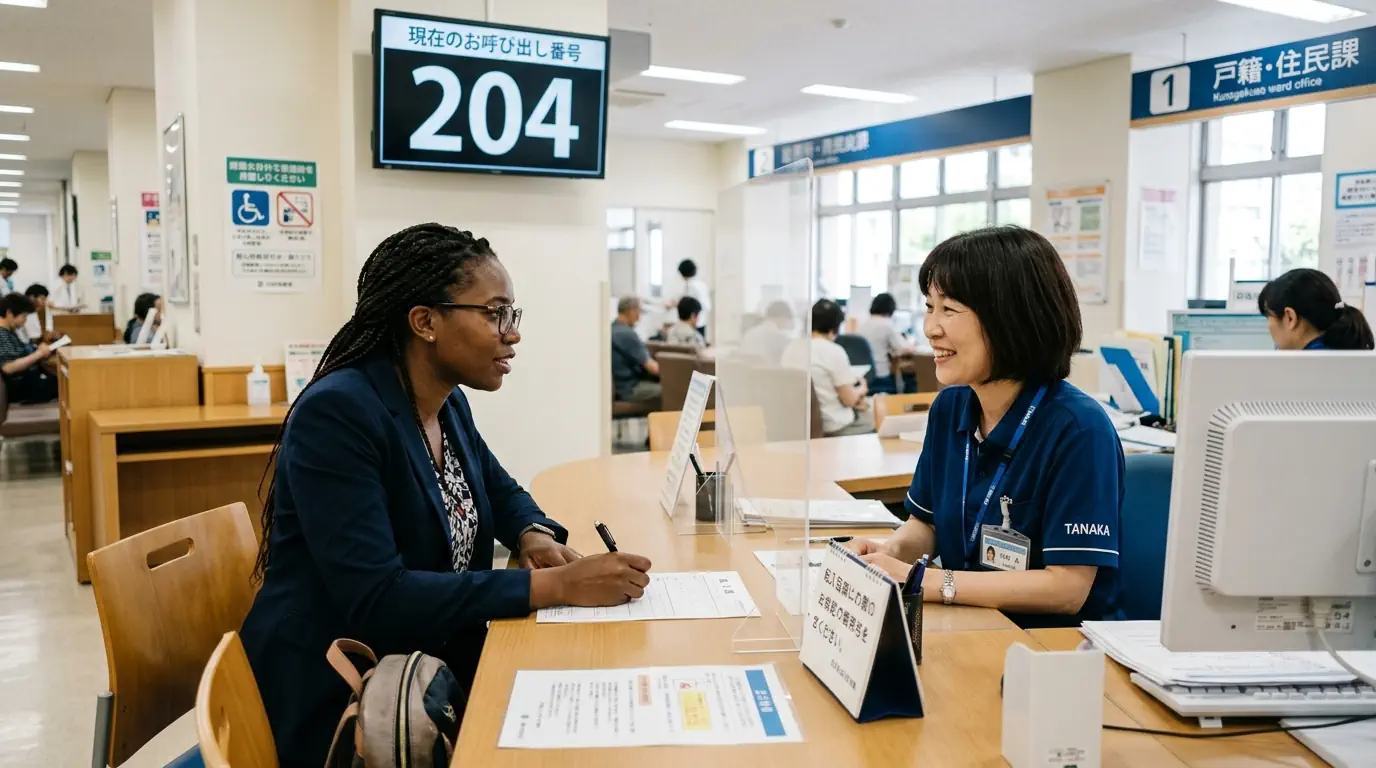
Day 3, you stand at the ward office counter with a form you cannot read. The clerk is polite and patient. She explains three times. You nod. You leave with the wrong stamp.
Day 9, your child has a fever at 11 p.m. You call the clinic. A recorded message plays. You hang up.
Day 20, your team goes out for drinks after work. Everyone is kind to you. Nobody talks to you after the first beer, because the real conversation switches to Japanese the moment you sit down.
None of this shows up in your relocation package, and all of it decides whether your assignment succeeds. Your colleagues will not say it, but they notice who makes the effort. Your partner, who did not choose this move, notices it first.
Why it fails
Apps and classes teach you Japanese for a tourist, not for a resident
You have probably already tried something.
Duolingo gave you a streak and the word for "apple". It never taught you how to tell a landlord the water heater is broken.
Weekly group classes start with the alphabet and move at the speed of the slowest student. At that pace, you speak in two years. Your move is in four months.
A textbook follows its own order: chapter 7 is "at the zoo". You will never go to the zoo. You will go to the bank, the hospital and the city hall.
A random tutor online chats with you about your weekend. Pleasant, but without a plan, a deadline or a method to make words stick.
The problem was never your talent for languages. It is the order. Everything you tried was built for someone with no deadline and no specific life to prepare for.
The program
Three phases, one goal: be ready before the plane lands
Days 1 to 30: survive
Read hiragana and katakana in 10 days.
The 1,600 words of daily life: shops, transport, home, food, numbers, time.
Your first 12 "landing scripts": residence card, bank account, phone contract, apartment problems.
Days 31 to 60: settle
Health, school and administration, the situations that scare everyone.
Polite Japanese for the office: introductions, meetings, emails.
Live rehearsals of the doctor visit and the ward office, with me playing the clerk.
Days 61 to 90: belong
Conversation: opinions, small talk, the after-work drinks.
Casual Japanese with neighbours and your children's friends' parents.
A final simulation of your first week in Japan, start to finish.
What you get
12 private coaching sessions with me, 60 minutes each, every week for 90 days.
6 live "situation rehearsals": ward office, landlord, clinic, bank, first day at work, after-work drinks.
Daily voice-message feedback, Monday to Friday. You send a recording, I correct your pronunciation and your register within 24 hours.
The Japan Landing Kit: the 3,178 sentences with rōmaji and English, organized in 90 daily pages, plus a 4,600-entry Japanese glossary.
Your personal 90-day calendar, adjusted to your move date and your city.
An invoice and a syllabus ready for your HR team, so your employer can cover the program.
Who is behind it
A method from someone who learned six languages as an adult
I am Bernard Duchene. I speak six foreign languages fluently, and I learned every one of them as an adult, with a job and a family.
For years, I have trained adults with no time and no patience for theory: apprentices, managers, engineers on deadlines. They all had the same need. They did not want to study a language, they wanted to use it next month.
The 5,000 words in 90 days method came out of that work. Japan Landing 90 is its most demanding version, because Japan is the move where English helps you the least.
Results
What clients say after their first month in Japan
"On my fourth day in Osaka I registered at the ward office alone. The clerk asked a question I had rehearsed with Bernard the week before. I almost laughed."
Daniel K., software architect, transferred to Osaka
"I followed my husband to Tokyo and was terrified of being isolated. Three months later, I chat with the other mothers at school pick-up. That changed everything for me."
Rachel M., accompanying spouse, Tokyo
"My company paid for it with the relocation budget. My Japanese manager told me after a month that the team appreciated the effort. That sentence was worth the whole program."
Tom H., finance director, Tokyo
✅ This is for you if
You move to Japan within the next six months, or you arrived less than six months ago.
You can protect at least 3 hours a week for 90 days.
You want to speak to people, not pass an exam.
You or your employer can invest in a premium 1:1 program.
❌ This is not for you if
You are curious about Japan but have no move planned.
You are looking for the cheapest option.
You want a certificate like the JLPT as your main goal.
You expect results without daily practice.
Guarantee
Handle your landing scripts by day 30, or I keep coaching you for free
By day 30, you will role-play your 12 landing scripts with me: residence card, bank, phone, apartment, and the rest.
If you cannot handle them in Japanese by then, we keep working together at no cost until you can. The only condition is that you did the daily work and sent your voice messages.
Questions
The questions people ask before applying
Is 90 days really enough to speak Japanese?
To be fluent, no. To live your daily life in Japanese, yes. You will not discuss philosophy, but you will handle the administration, the doctor, the shops, your colleagues and your neighbours. That is what this program promises, and nothing more.
I have a demanding job. Will I have the time?
The program asks 25 to 35 minutes a day plus your weekly session. Most clients do their daily practice on their commute or before breakfast. If you cannot protect 3 hours a week, please do not apply yet.
Can my employer pay for it?
Very often, yes. I provide an invoice in your company's name and a detailed syllabus that HR teams usually need to approve a language budget. Many transferees use their relocation allowance.
My partner is moving with me. Can we join together?
Yes. Mention it in your application. Accompanying partners often need Japanese even more than the employee, because they handle the school, the shops and the neighbours. I can build a plan for both of you.
I already know some Japanese. Is this too basic for me?
No. During our call, I place you on the 90-day calendar according to your level. If you already read kana, we go straight to the landing scripts.
What happens after I apply?
I read your application within 48 hours. If I think I can help you before your move, I send you a link to book a 30-minute call. If it is not the right fit, I tell you honestly and point you to a better option.
Already approved after your call? Secure your seat below.